MSME Development | DC MSME | MSME Development Schemes
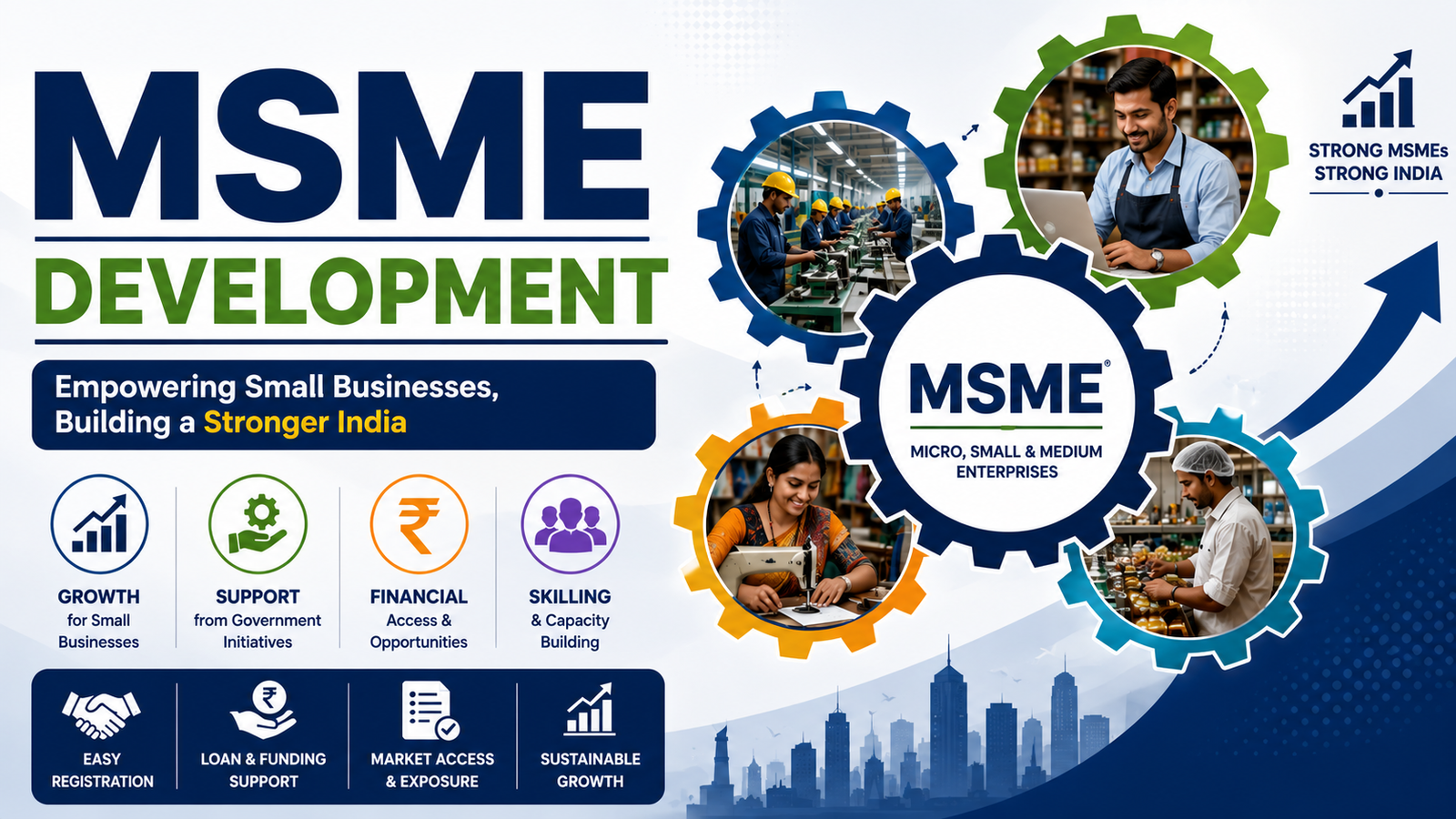
MSME development is an important part of India's economic growth because Micro, Small and Medium Enterprises contribute to employment generation, entrepreneurship, manufacturing, services and regional development. The Government of India supports MSMEs through different policies, financial assistance programmes, technology support, skill development initiatives, market-access programmes and entrepreneurship development activities.
For entrepreneurs planning to start or expand a business, Udyam Registration Portal is an important starting point because Udyam Registration provides official recognition to eligible enterprises as MSMEs. The government also operates various digital platforms and support mechanisms through the Ministry of Micro, Small & Medium Enterprises and the Office of the Development Commissioner (MSME).
The term MSME development covers much more than business registration. It includes improving productivity, access to finance, technology adoption, market opportunities, entrepreneurship, training, infrastructure and competitiveness.
In this article, we will explain MSME development, DC MSME, MSME Development Institutes, MSME schemes, entrepreneurship development, skill development, testing centres, Common Facility Centres and other important concepts related to MSMEs.
What Is MSME Development?
MSME development refers to the process of supporting and strengthening micro, small and medium enterprises so that they can start, survive, expand and compete effectively.
The development of MSMEs may include:
-
Financial and credit support
-
Technology upgradation
-
Entrepreneurship development
-
Skill development
-
Market promotion
-
Quality improvement
-
Product testing
-
Infrastructure development
-
Training and consultancy
-
Innovation and incubation
-
Export and market-access support
-
Cluster development
The objective is to create an environment where small businesses can become more productive and sustainable.
The Ministry of Micro, Small & Medium Enterprises implements and supports several programmes covering employment, credit, clusters, entrepreneurship, procurement, marketing, innovation and other areas. The Ministry's current scheme booklet includes programmes such as PMEGP, CGTMSE, MSE-CDP, SFURTI, Entrepreneurship Skill Development Programme, Procurement & Marketing Support and International Cooperation.
Ministry of Micro, Small and Medium Enterprises
The Ministry of Micro, Small & Medium Enterprises (MSME Ministry) is the central government ministry responsible for policies and programmes relating to MSMEs.
It works to promote the growth and competitiveness of MSMEs through various initiatives.
Major areas of support include:
-
Entrepreneurship development
-
Employment generation
-
Credit facilitation
-
Skill development
-
Technology improvement
-
Marketing assistance
-
Cluster development
-
Innovation
-
Quality improvement
-
Support for disadvantaged entrepreneurs
The Ministry also provides online platforms through which entrepreneurs can access registration, scheme information and other MSME services.
What Is DC MSME?
DC MSME means the Development Commissioner (MSME) under the Ministry of Micro, Small & Medium Enterprises.
The Office of the Development Commissioner (MSME) plays an important role in implementing programmes and providing institutional support to MSMEs.
The official DC MSME website provides information about schemes, policies, notifications, programmes, MSME Development and Facilitation Offices, technology centres and other support mechanisms.
You can visit the official DC MSME website for government information and updates.
What Is an MSME Development Institute?
An MSME Development Institute (MSME-DI), now generally referred to within the DC MSME network as an MSME Development and Facilitation Office, provides support to entrepreneurs and MSMEs.
These offices can assist businesses through activities such as:
-
Entrepreneurship development programmes
-
Skill and managerial training
-
Awareness programmes
-
Technical guidance
-
Consultancy
-
Market-related assistance
-
Cluster development
-
Technology-related support
-
Information about government schemes
The DC MSME network includes MSME Development and Facilitation Offices, Branch Offices, Technology Centres and Technology Support institutions. Current DC MSME records also show active administrative and financial activities for MSME-DFOs and related institutions during FY 2026-27.
MSME DI and DC MSME
People searching for MSME DI, MSME Development Institute, MSME DI DCMSME or micro small and medium enterprises development institute are generally looking for government support offices associated with the Development Commissioner (MSME).
These institutions are useful for entrepreneurs who need information about:
-
MSME schemes
-
Training programmes
-
Entrepreneurship
-
Technology
-
Product development
-
Quality improvement
-
Marketing
-
Cluster development
Therefore, MSME-DIs can act as an important connection between government MSME programmes and entrepreneurs.
What Is the Purpose of MSME Development?
The primary purpose of MSME development is to strengthen small businesses and create an ecosystem where entrepreneurs can grow.
Important objectives include:
1. Employment Generation
MSMEs create employment opportunities in manufacturing, trading and service activities.
2. Entrepreneurship Promotion
Government programmes encourage individuals to establish new enterprises and develop entrepreneurial skills.
3. Technology Development
Technology support helps enterprises improve productivity, quality and competitiveness.
4. Market Development
Marketing programmes can help eligible enterprises participate in exhibitions, trade fairs and other market-access activities.
5. Skill Development
Training programmes improve technical, managerial and entrepreneurial capabilities.
6. Better Access to Finance
Credit-related schemes and guarantee mechanisms aim to improve access to institutional finance for eligible enterprises.
7. Regional Development
MSMEs can promote industrial activity beyond major metropolitan centres and contribute to local economic development.
Important MSME Development Schemes
The Government of India provides several schemes for MSMEs. Scheme eligibility and assistance differ according to the programme, so entrepreneurs should always check the current official guidelines before applying.
Prime Minister's Employment Generation Programme
PMEGP is designed to support employment-generating micro-enterprises through financial assistance linked to bank finance.
It is particularly relevant for individuals planning to establish new micro-enterprises.
Credit Guarantee Scheme for Micro & Small Enterprises
Credit guarantee support helps eligible micro and small enterprises obtain institutional credit without relying entirely on traditional collateral requirements.
The current MSME scheme booklet lists the Credit Guarantee Scheme among the major schemes implemented by the Ministry.
Micro & Small Enterprises Cluster Development Programme
The cluster approach helps groups of enterprises access common infrastructure, technology and other support.
This type of development can be especially useful where several businesses operate within the same industrial or product cluster.
Entrepreneurship Skill Development Programme
The Entrepreneurship Skill Development Programme (ESDP) focuses on developing entrepreneurial and managerial capabilities.
It can help aspiring entrepreneurs understand business planning, enterprise management and other practical aspects of running a business.
Procurement & Marketing Support Scheme
The Procurement & Marketing Support Scheme helps eligible MSEs improve market access through activities such as trade fairs, exhibitions, packaging awareness, GeM-related awareness and other market-development initiatives.
The Ministry states that manufacturing and service-sector MSEs with valid Udyam Registration can be eligible under the scheme, subject to applicable conditions.
Innovation and Incubation Support
The MSME Innovative Scheme includes incubation-related support for developing ideas and encouraging innovation.
The DC MSME's 2026 records show financial assistance being released for approved ideas under MSME IDEA HACKATHON 4.0.
MSME Entrepreneurship Development
MSME entrepreneurship development focuses on helping individuals acquire the knowledge and capabilities required to establish and manage enterprises.
Entrepreneurship development programmes may cover:
An MSME Entrepreneurship Development Programme can therefore be useful for both new entrepreneurs and existing business owners who want to improve their management capabilities.
MSME Skill Development
MSME skill development focuses on improving the practical and technical abilities of entrepreneurs, workers and potential business owners.
Skill development can support:
-
Technical skills
-
Production skills
-
Digital skills
-
Business management
-
Quality management
-
Entrepreneurship
-
Marketing
-
Financial literacy
Training and capacity building are important because technology, customer expectations and market conditions continue to change.
MSME Testing Centre
An MSME Testing Centre provides testing and technical services that can help businesses evaluate products and improve quality.
Product testing can be important for enterprises involved in manufacturing because quality and technical compliance can affect customer acceptance and market access.
MSME Technology Centres and related institutions form part of the wider support infrastructure associated with the Office of the Development Commissioner (MSME).
Entrepreneurs should check the relevant centre for available testing facilities, applicable charges and technical requirements.
Common Facility Centre for MSMEs
A Common Facility Centre (CFC) is shared infrastructure created to support enterprises, particularly within clusters.
Instead of every small business purchasing expensive machinery or infrastructure independently, common facilities can provide access to shared resources.
A CFC may provide facilities such as:
The cluster-based approach can reduce the cost of accessing modern infrastructure and improve the competitiveness of participating enterprises.
MSME Green Industrial Park
The concept of green industrial development focuses on making industrial activities more environmentally sustainable.
For MSMEs, green development can involve:
Businesses adopting cleaner technologies may improve resource efficiency while also responding to increasing environmental expectations.
MSME Dairy Scheme
People often search for MSME dairy scheme when looking for government support for dairy-related businesses.
Dairy businesses may fall under different government programmes depending on the nature of the activity, enterprise structure, location and type of investment.
Therefore, entrepreneurs should not assume that every dairy business automatically qualifies for a particular MSME scheme. The latest eligibility criteria of the relevant programme should be checked before applying.
MSME Tread Scheme
The term TReDS is different from a conventional MSME subsidy scheme.
TReDS refers to an electronic platform-based mechanism that helps facilitate financing of trade receivables of MSMEs through participating financiers.
The Ministry's MyMSME portal currently encourages MSME units to onboard on TReDS and identifies platforms including RXIL, M1xchange and Invoicemart.
This can be particularly relevant for businesses facing delays in receiving payments from eligible buyers.
MSME Schemes by Government
The government provides MSME support through multiple programmes rather than one single scheme.
Depending on the enterprise and objective, an entrepreneur may explore support related to:
The official DC MSME scheme resources contain information on multiple programmes, while the current MSME scheme booklet provides a consolidated overview of major schemes.
What Is the Relationship Between Udyam Registration and MSME Development?
Udyam Registration and MSME development are closely connected.
Udyam Registration provides official MSME recognition to eligible enterprises, while government development programmes provide different forms of assistance for eligible businesses.
For example, the Procurement & Marketing Support Scheme specifically lists a valid Udyam Registration Certificate as an eligibility condition for manufacturing and service-sector MSEs.
Therefore, entrepreneurs should keep their Udyam details accurate and updated and should check individual scheme requirements before applying.
The official MyMSME portal also warns users about fake websites and identifies the official Udyam Registration website as the government portal.
MSME Development Bill and MSMED Act
The phrase MSME Development Bill is sometimes used in searches to refer to legislation concerning the development and regulation of MSMEs.
The principal legislation is the Micro, Small and Medium Enterprises Development Act, 2006 (MSMED Act, 2006).
The Act provides a legal framework relating to micro, small and medium enterprises and includes provisions concerning areas such as definitions, the National Board for MSMEs and delayed-payment-related matters.
The official DC MSME website maintains a dedicated section for the MSMED Act 2006, notifications, policies and related issues.
For legal matters, businesses should rely on the latest official Act, notifications and government rules rather than outdated articles referring to an old "MSME Development Bill."
MSME Development Corporation
An MSME Development Corporation generally refers to an organisation established at the state or institutional level to promote MSME activities.
Such organisations may provide support related to:
The exact role and services differ from one state or organisation to another.
Therefore, entrepreneurs searching for an MSME development corporation should identify the relevant state or government organisation before applying for any service.
How to Find an MSME Centre Near Me
If you are searching for an MSME centre near me, the appropriate office depends on your location and the service you require.
You can check the official DC MSME network for the relevant MSME Development and Facilitation Office, Branch Office or Technology Centre.
Before visiting, check:
-
Office address
-
Working hours
-
Available services
-
Contact details
-
Required documents
-
Appointment requirements, if applicable
Using official government websites is preferable to relying on unverified third-party listings.
Official MSME Websites and Resources
For reliable MSME information, entrepreneurs should primarily use government websites.
DC MSME
Official DC MSME Website
It provides information about MSME schemes, policies, notifications, offices and development programmes.
Ministry of MSME
Ministry of MSME
This is the official Ministry website for schemes, services and policy information.
MyMSME
MyMSME Portal
The portal provides access to several MSME-related services and schemes.
Benefits of MSME Development for Entrepreneurs
Effective MSME development can provide several advantages to businesses.
Better Business Knowledge
Training programmes can improve entrepreneurial and managerial capabilities.
Technology Access
Technology-related programmes can help enterprises adopt improved machinery and processes.
Market Opportunities
Marketing assistance can help eligible businesses access trade fairs, exhibitions and other market-development opportunities.
Improved Competitiveness
Quality, technology and skill-development support can help businesses become more competitive.
Access to Government Support
Udyam-registered enterprises can explore schemes for which they meet the relevant eligibility conditions.
Employment Creation
The growth of MSMEs can contribute to employment generation and local economic development.
Frequently Asked Questions
1. What is MSME development?
MSME development is the process of supporting micro, small and medium enterprises through finance, technology, training, entrepreneurship, infrastructure, marketing and other government initiatives.
2. What is DC MSME?
DC MSME stands for Development Commissioner (MSME), an office under the Ministry of Micro, Small & Medium Enterprises.
3. What is an MSME Development Institute?
An MSME Development Institute is part of the government support network that provides training, consultancy, awareness and other development assistance to MSMEs.
4. What is MSME DI?
MSME DI is commonly used for MSME Development Institute. Current government resources also use the term MSME Development and Facilitation Office for offices within the DC MSME network.
5. What is the purpose of MSME development?
Its purpose is to improve entrepreneurship, employment, productivity, technology, market access and competitiveness of MSMEs.
6. What are major MSME government schemes?
Major programmes include PMEGP, Credit Guarantee Scheme, MSE-CDP, SFURTI, ESDP, Procurement & Marketing Support and innovation-related programmes.
7. What is an MSME Testing Centre?
It is a technical support facility that can provide testing and related services to eligible enterprises depending on the centre's facilities.
8. What is a Common Facility Centre?
A Common Facility Centre provides shared infrastructure, machinery, testing or other facilities to enterprises, particularly those operating within clusters.
9. What is MSME entrepreneurship development?
It refers to programmes designed to improve entrepreneurial, managerial and business-development capabilities.
10. Is Udyam Registration important for MSMEs?
Yes. Udyam Registration provides official recognition to eligible enterprises, and certain government schemes specifically require valid Udyam Registration.
11. What is the MSMED Act?
The Micro, Small and Medium Enterprises Development Act, 2006 is the principal legislation concerning MSME development and related legal provisions.
12. Where can I check MSME schemes?
You should check the official Ministry of MSME, DC MSME and MyMSME portals for the latest scheme information and eligibility requirements.
Conclusion
MSME development plays an important role in strengthening India's small-business ecosystem. It includes much more than obtaining an MSME registration certificate. Entrepreneurs can explore government support related to finance, credit guarantees, technology, skill development, entrepreneurship, marketing, innovation, cluster infrastructure and market access.
The Ministry of Micro, Small & Medium Enterprises and the Development Commissioner (MSME) provide a wide network of programmes and institutions for MSMEs. MSME Development and Facilitation Offices, Technology Centres, testing facilities and Common Facility Centres can further support businesses at different stages of development.
For entrepreneurs, the best approach is to first complete the appropriate Udyam-related formalities and then identify government schemes according to the business activity and specific requirement. Since scheme guidelines, eligibility conditions and application windows can change, always verify the latest information through official government portals before applying.