Udyam Registration for Proprietorship Firms: Step-by-Step Guide
If you operate a proprietorship business in India, Udyam Registration can provide a formal MSME identity for your enterprise. Whether you run a small manufacturing unit, retail business, consultancy, trading activity, service business, or another eligible enterprise, understanding the registration process can help you manage your MSME records more effectively.
Udyam Registration is the official MSME registration framework introduced by the Government of India. The registration process is online, and eligible enterprises receive a permanent Udyam Registration Number along with an udyam registration certificate after successful registration.
For a proprietorship, the process is closely connected to the proprietor's Aadhaar and the enterprise's PAN and other business information. However, registration does not automatically make every business eligible for every government benefit. Eligibility and applicable requirements should always be checked for the particular scheme or facility.
This guide explains who can apply, what information may be required, how to complete Udyam Registration step by step, and what to do after receiving the certificate.
What Is Udyam Registration?
Udyam Registration is the government registration system for Micro, Small and Medium Enterprises (MSMEs) in India. It replaced the earlier Udyog Aadhaar registration system.
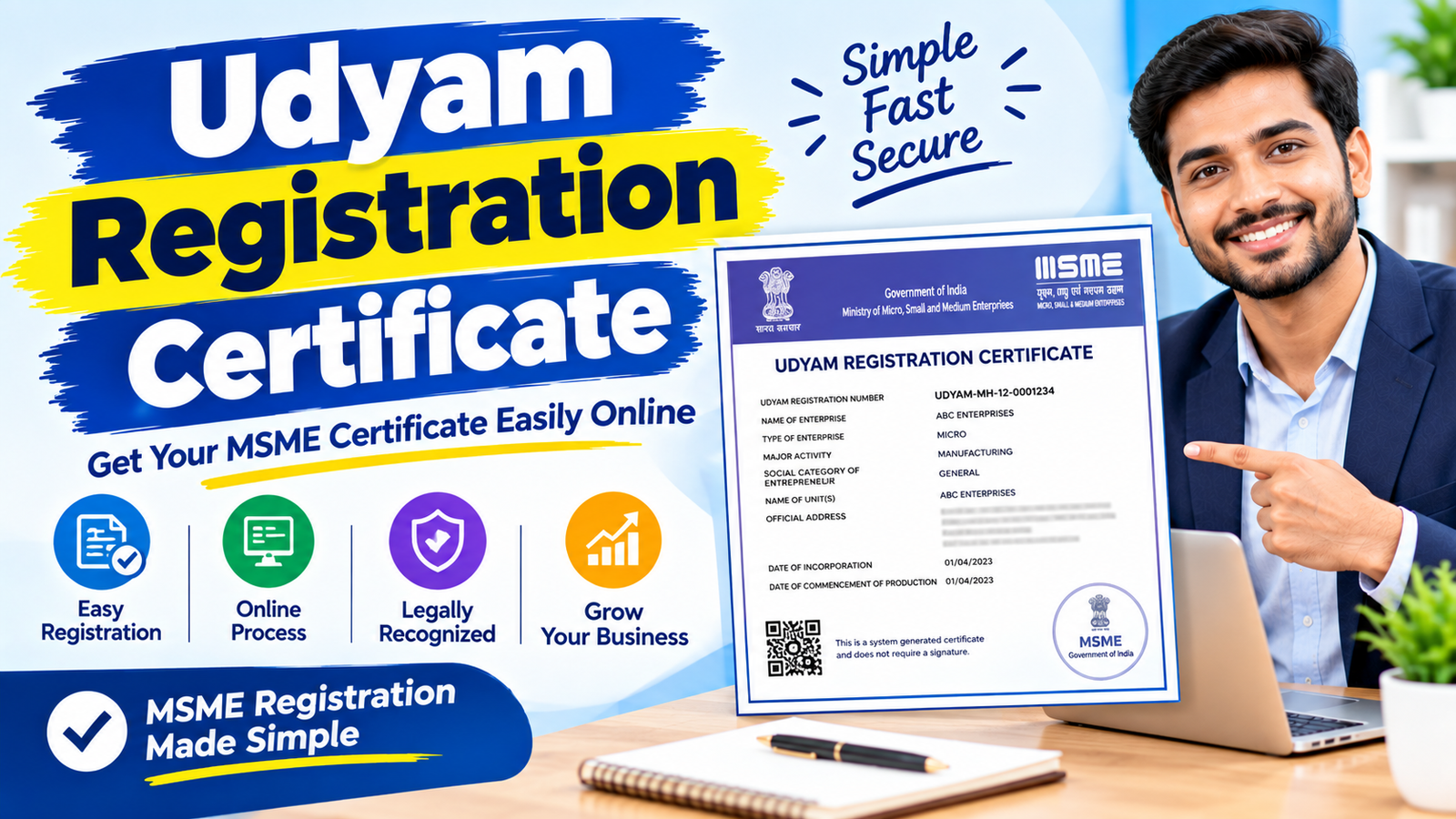
An eligible enterprise that completes the registration receives a unique Udyam Registration Number. The enterprise can also download its Udyam Registration Certificate, which contains important details associated with the registered business.
The registration is designed to create a simpler online process for MSMEs. The information provided during registration is authenticated through government databases, including Aadhaar and PAN-related information.
For a proprietorship, the enterprise and proprietor are closely connected because the proprietor owns and operates the business.
Can a Proprietorship Firm Apply for Udyam Registration?
Yes. An eligible proprietorship business can apply for Udyam Registration.
A proprietorship does not have a separate legal identity from its owner in the same way that a company or LLP does. Therefore, the proprietor's details are important during the registration process.
A proprietor may operate a business such as:
- Retail or wholesale activities
- Professional services
- Consulting
- Manufacturing
- Repair and maintenance services
- Information technology services
- Online businesses
- Food-related businesses
- Construction-related activities
- Other eligible business activities
The exact eligibility depends on the applicable MSME classification and registration requirements.
Why Should a Proprietor Consider Udyam Registration?
Udyam Registration can be useful for establishing an official MSME identity for an eligible enterprise. Depending on the applicable rules and scheme requirements, MSMEs may be able to access certain government programmes, incentives, procurement opportunities, or other facilities.
Some potential advantages include:
1. MSME Identification
Udyam Registration gives an eligible enterprise a unique registration number and certificate.
2. Access to Applicable MSME Schemes
Some government schemes are specifically available to MSMEs. However, registration alone does not guarantee eligibility. Each scheme can have its own conditions.
3. Easier Documentation
The Udyam Registration Certificate can serve as a convenient document containing the enterprise's registration information.
4. Government Procurement Opportunities
Registered MSMEs may be able to participate in certain government procurement programmes subject to the relevant tender and eligibility conditions.
5. Business Record Management
Maintaining an official MSME registration can make it easier to keep important business information organized.
Udyam Registration Classification for Proprietorship Businesses
Before applying, a proprietor should understand that MSMEs are classified according to prescribed investment and turnover criteria.
The classification framework includes:
- Micro Enterprise
- Small Enterprise
- Medium Enterprise
The applicable investment and turnover limits are determined under the MSME framework and can be revised by the government from time to time.
Because these thresholds can change, businesses should check the latest official criteria before submitting their registration information.
A proprietorship should provide accurate financial and business information. Incorrect information can create problems when the registration details are verified or used for other purposes.
Documents and Information Required for Udyam Registration
One advantage of the online registration process is that applicants generally do not need to upload a large collection of traditional business documents.
However, certain information is required for authentication and registration.
A proprietor should generally keep the following information available:
Aadhaar Details
The proprietor's Aadhaar is important for the Aadhaar authentication process.
PAN Details
The enterprise's PAN information is required as applicable under the registration process.
Mobile Number
A working mobile number may be required for OTP verification and communication.
Business Name
The proprietor should provide the name under which the enterprise operates.
Business Address
The registered or operating location details of the enterprise should be entered accurately.
Bank Details
Relevant bank account information may be required as part of the enterprise details.
Business Activity
The proprietor needs to identify the nature of the business and applicable activity information.
NIC Code
The appropriate National Industrial Classification (NIC) code should be selected according to the enterprise's actual business activity.
It is important to choose an appropriate code rather than selecting a random category simply because it appears similar.
Step-by-Step Udyam Registration Process for a Proprietorship
The following steps provide a practical overview of how a proprietor can approach the registration process.
Step 1: Visit the Udyam Registration Portal
Start by accessing the official Udyam Registration system.
The proprietor should use the official government portal rather than relying on unofficial websites claiming to be government registration portals.
Before entering personal or business information, verify that you are using the correct website.
Step 2: Start a New Udyam Registration
Select the option for applicants who are not already registered as an MSME under the Udyam system.
The portal will guide the applicant through the required Aadhaar authentication process.
For a proprietorship, the Aadhaar of the proprietor is relevant to the registration.
Step 3: Complete Aadhaar Verification
Enter the proprietor's Aadhaar information as requested and complete the OTP-based authentication.
The name associated with Aadhaar may need to match the information used during the application.
If authentication fails, check the entered details and follow the portal's instructions before attempting the process again.
Step 4: Provide PAN Information
After Aadhaar authentication, the proprietor may need to provide PAN-related information.
PAN is important because the registration system uses tax-related information for verification and enterprise classification.
Make sure the PAN details are entered correctly.
Step 5: Enter the Enterprise Details
The next stage involves providing information about the business.
Depending on the portal's current form, this may include details such as:
- Name of the enterprise
- Type of organization
- Proprietor information
- Business address
- Contact details
- Date of commencement
- Bank account information
- Business activity
- Number of employees
- Investment-related information
- Turnover-related information
Enter the information carefully and avoid using inaccurate estimates.
Step 6: Select the Appropriate NIC Code
The NIC code identifies the nature of the enterprise's business activity.
For example, a proprietor operating a consultancy business should select a code that appropriately represents the consultancy activity. A manufacturer should select the relevant manufacturing activity.
Businesses with multiple activities may need to provide more than one applicable activity, depending on the portal's available options.
Choosing the right NIC code helps ensure that the registration accurately represents the enterprise.
Step 7: Review the Information
Before submitting the application, carefully review every field.
Pay particular attention to:
- Proprietor name
- Aadhaar-related information
- PAN
- Enterprise name
- Business address
- Mobile number
- Email address
- Bank information
- Business activity
- NIC code
- Employee information
- Investment and turnover details
A small spelling or numerical error can create difficulties later when the certificate is used for business purposes.
Step 8: Submit the Application
Once all details have been reviewed, submit the registration information through the portal.
The system may perform authentication and validation using the information supplied by the applicant.
After successful completion, the enterprise receives its Udyam Registration Number.
How to Download the Udyam Registration Certificate
After successful registration, the proprietor can access the registration information and download the udyam registration certificate through the Udyam system.
The certificate generally contains important enterprise details, including the Udyam Registration Number and information associated with the registered business.
Keep a digital copy in a secure location. You may also print a copy for your business records.
If you cannot locate your certificate, use the appropriate certificate-print or verification facility available through the official Udyam system.
What Is the Udyam Registration Number?
The Udyam Registration Number is the unique identification number assigned to a registered enterprise.
It is different from:
- PAN
- GSTIN
- Bank account number
- Old Udyog Aadhaar number
A proprietor should keep the Udyam Registration Number safely because it may be required when using the MSME registration for applicable business or government-related purposes.
Does Udyam Registration Need Renewal?
Udyam Registration is designed as a permanent registration and does not generally require periodic renewal in the same way as some other registrations.
However, enterprises should keep their information accurate and update relevant details when changes occur.
For example, if business information, contact details, activities, or financial information changes, the proprietor should review the applicable update requirements.
This is particularly important because MSME classification can depend on investment and turnover information.
Updating Udyam Registration Details
A proprietorship business can experience changes over time.
For example:
- Business address may change.
- Mobile number may change.
- Email address may change.
- Business activities may expand.
- Additional NIC activities may become relevant.
- Financial information may change.
- Employee information may change.
Instead of creating unnecessary duplicate registrations, the proprietor should review the applicable update facility and maintain the existing registration appropriately.
Accurate information helps keep the udyam registration certificate aligned with the enterprise's current records.
Common Mistakes to Avoid
Several mistakes can create unnecessary problems during Udyam Registration.
Using an Unofficial Website
Always verify the registration portal before submitting sensitive information.
Entering Incorrect Aadhaar Information
Aadhaar authentication is an important part of the process for a proprietorship.
Choosing the Wrong NIC Code
Select an activity that genuinely represents the business.
Providing Incorrect Financial Information
Investment and turnover information should be accurate and consistent with the applicable requirements.
Creating Multiple Registrations Unnecessarily
A proprietor should understand the registration structure before attempting to create another Udyam registration.
Ignoring Updates
If important enterprise details change, review whether the Udyam information should be updated.
Udyam Registration vs Udyog Aadhaar
Udyog Aadhaar was the earlier MSME registration mechanism. Udyam Registration is the current MSME registration system.
Therefore, business owners searching for terms such as "Udyog Aadhaar print," "Udyog Aadhaar certificate," or "Udyog Aadhaar registration" should understand that these terms often refer to the older system.
New applicants should follow the current Udyam Registration process rather than attempting to create a new Udyog Aadhaar registration.
Existing businesses with older records may need to understand the applicable transition or current-registration requirements.
Is Udyam Registration Free?
The official Udyam Registration process is intended to be available without a registration fee on the government portal.
Applicants should be cautious about websites that present unnecessary charges as mandatory government registration fees.
Some private service providers may offer assistance for completing forms or handling documentation. Any such service charge is separate from a government registration fee.
Always distinguish between a government fee and a private service provider's professional or assistance charges.
Udyam Registration for Proprietorship Firms: Key Takeaways
For a proprietorship business, Udyam Registration provides a formal MSME registration framework through which an eligible enterprise can obtain a unique Udyam Registration Number and certificate.
The proprietor should:
- Verify MSME eligibility.
- Keep Aadhaar and PAN information ready.
- Enter accurate business details.
- Select appropriate NIC codes.
- Review the application before submission.
- Keep the Udyam Registration Number safely.
- Download and preserve the udyam registration certificate.
- Update relevant information when required.
- Check the latest government rules for specific schemes or benefits.
Udyam Registration can be a useful part of maintaining formal MSME records, but registration should not be treated as an automatic qualification for every government benefit. Specific schemes and facilities can have separate eligibility conditions.
Frequently Asked Questions
1. Can a proprietorship firm apply for Udyam Registration?
Yes. An eligible proprietorship firm can apply for Udyam Registration. The official Udyam portal specifically states that the Aadhaar number used for a proprietorship firm must belong to the proprietor.
Authentic Source: Udyam Registration – Official Government Portal
2. Which Aadhaar is required for Udyam Registration of a proprietorship?
For a proprietorship firm, the Aadhaar number of the proprietor is required for Udyam Registration. The official registration form confirms this requirement.
Authentic Source: Official Udyam Registration Form
3. Is Udyam Registration free for proprietorship firms?
Yes. The official Udyam Registration portal states that there is no fee for filing Udyam Registration and warns applicants against paying registration charges to unauthorized parties.
Authentic Source: Udyam Registration – Important to Know
4. What is an Udyam Registration Certificate?
After successful registration, an enterprise is assigned a permanent Udyam Registration Number, and an electronic Udyam Registration Certificate is issued. The certificate serves as the MSME registration document for the registered enterprise.
Authentic Source: Udyam Registration Official Portal
5. Does a proprietorship need to upload documents for Udyam Registration?
The official Udyam portal states that the registration process is paperless and that applicants do not need to upload documents, papers, certificates, or proof for registration. Information is verified through government databases where applicable.
Authentic Source: Udyam Registration – Official Guidelines
6. Is PAN required for Udyam Registration?
PAN is part of the Udyam Registration process, and the official portal states that PAN and applicable GST-linked information are used for MSME classification. The specific requirements can depend on the enterprise and applicable GST provisions.
Authentic Source: Udyam Registration – Official Portal
7. Can a service-based proprietorship obtain Udyam Registration?
Yes. The MSME classification framework applies to both manufacturing and service enterprises. The Ministry of MSME explains that the current classification framework covers both sectors.
Authentic Source: MSME Annual Report – Ministry of MSME
8. Does a business need more than one Udyam Registration for different activities?
No. The official Udyam portal states that an enterprise should not file more than one Udyam Registration. Multiple activities, including manufacturing and services, can be specified or added under one registration.
Authentic Source: Udyam Registration – Official Guidelines
9. Does Udyam Registration have an expiry date?
The official Udyam framework assigns a permanent Udyam Registration Number to a registered enterprise. However, enterprises should keep their information updated and comply with applicable requirements.
Authentic Source: Udyam Registration – Official Government Portal
10. Where should a proprietorship apply for Udyam Registration?
A proprietorship should use the official Udyam Registration portal of the Ministry of MSME. The Ministry's own website lists Udyam Registration as the official online MSME registration service, and the government portal warns against fake websites.
Authentic Sources: Udyam Registration – Government Portal and Ministry of MSME – Important Links
Useful Official Government Sources
Official Udyam Registration Form